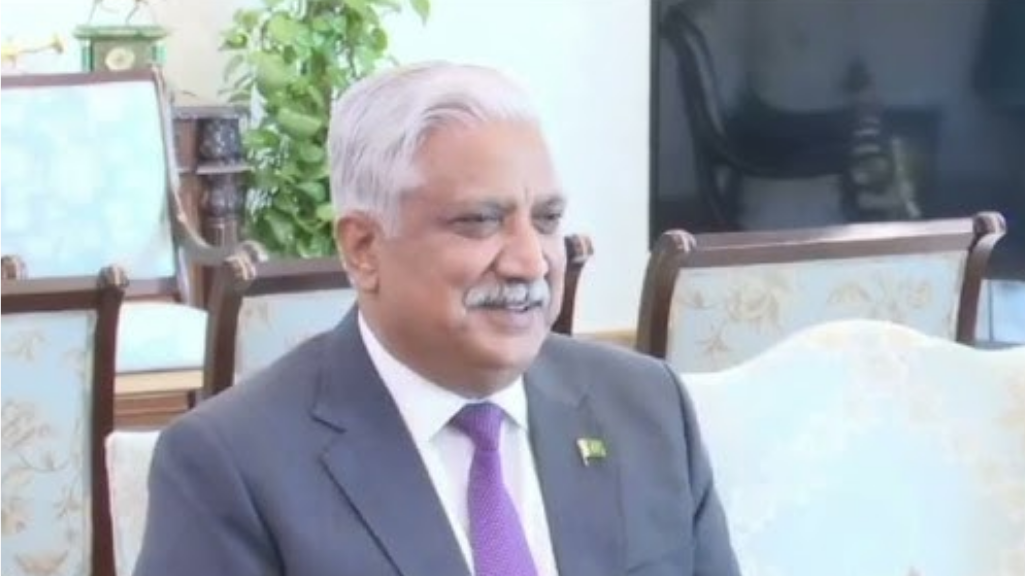
Urdu International (Monitoring Desk) Lt Gen Saeed (Retd) stated on X that Pakistanis who are following the Iran-US war and post ceasefire events closely are a touch dejected. Generally, people continue to desire for final agreement between Iran-US to be a result of predominantly Pakistan’s role .We must remember, current deadlock is a global concern, hence, broader facilitation/mediation will definitely have better chances of prevailing fragile ceasefire transitioning into an early and enduring agreement .Involvement of regional countries, particularly a proactive and assuring role by China and Russia, will further curtail chances of both sides reverting to use of kinetic options .Though a dominant role either by China or Russia will .be a setback for the US, broader the involvement better it will be for world peac
Let us not forget, bringing the parties to conflict back from the brink of bloodshed and destruction on the morning of 8th April and first ever engagement between Iran and US at political level are historical achievements. Pakistan’s contribution in realization of these historical achievements for world peace has been and is being continuously acknowledged/appreciated, world over. None will ever be able to erase it from history as Pakistan’s global moment. We can all continue to be proud of our accomplishment.
The current situation may be viewed in the context of following competing realities.
Iranians perhaps have a firm assessment that rising internal and external political cost for Mr. Trump has seriously curtailed his options to force maximalist demands on Iran. Longer the deadlock persists, more widespread and stronger will be criticism of US leadership, both by friends as well as rivals. Hence, despite worsening economic challenges for Iran, they have an opportunity to minimize US demands.
US and Iran’s blockade of Hormuz affect every nation state in the region and beyond, not only Iran. Despite the blockade, Iranian trade cannot be brought to zero. That is dividend of geography Iran has, and their leadership has mastery over its exploitation. They did so all along the decades of sanctions.
Both sides have most likely concluded that media war and rhetoric have not served the purpose, hence, a visible restraint from both sides during last 24 hours. If maintained, it will strengthen options for the second round of negotiations.
The future status of the Strait of Hormuz is likely to be decided regionally, with a supporting role by the US.
Military, particularly naval buildup in the region, has not been able to pressure Iran to regress, hence, it can only lead to unintended escalation. Thus far, it has remained short of becoming a credible coercive instrument. The US should consider reducing global anxiety through a pause in further buildup.
Iran will not accept any proposal that can be interpreted as ‘surrender’. US will not accept a solution that further cements a popular perception that Mr. Trump got US involved in an unnecessary war, under Israeli pressure. The Challenge – equitable face-saving for both Iran and the US.
Last but most important, let us hope the US understands that attempted regime change has made the realization of their geopolitical and geostrategic objectives for Iran far more difficult and distant compared to the possibilities that existed till 27 Feb 26. Needless to mention, the international community is paying a very high cost for an ill-conceived US policy and flawed military strategy. The attempt has pushed Iranian statecraft towards more resilient decision-making. In the June 25 conflict, exit was orchestrated through a managed strike on a US base in Qatar. A similar face-saving doesn’t appear possible anymore, hence, a need for the US strategic community to review the gains of the unjust, illegal, and failed regime change project.